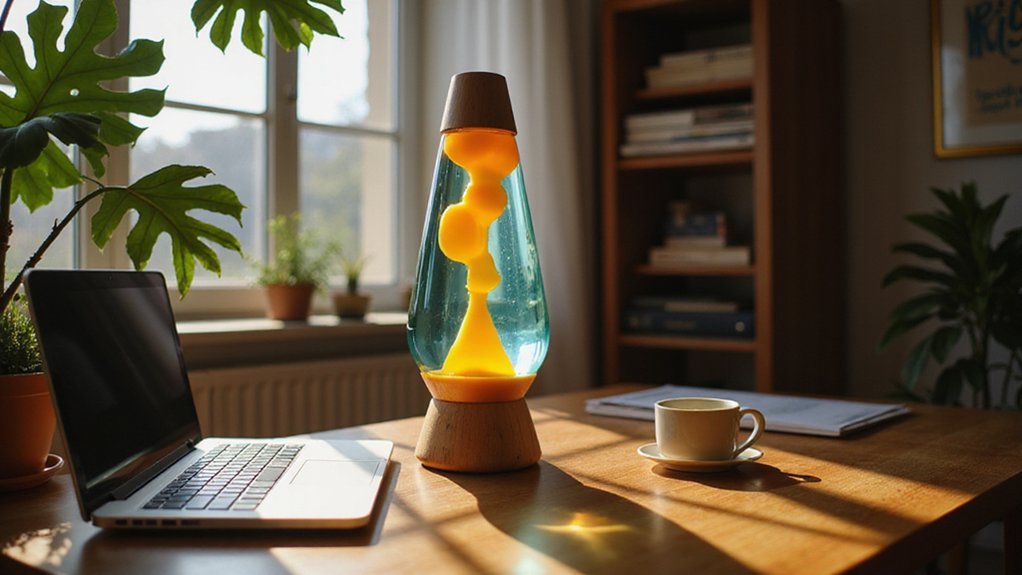
Ever wondered how a lava lamp creates those mesmerizing blobs that seem to dance endlessly? It all comes down to simple science involving heat, density, and a bit of magic.
When you turn on a lava lamp, the heat from the bulb warms the wax at the bottom. This causes the wax to expand and become less dense, making it rise through the liquid.
As it moves away from the heat, it cools, contracts, and sinks again. The cycle repeats itself, keeping the blobs flowing without any moving parts. Keep reading to learn more about how it all works.
What’s Actually Inside a Lava Lamp?
Inside a lava lamp, you’ll find two main components: a clear or dyed liquid and waxy “lava” blobs. The liquid is usually water combined with preservatives to prevent bacterial growth and salt to fine-tune its density. The wax isn’t just pure paraffin; it’s blended with mineral oil and other density-adjusting agents. No chemical reactions occur inside—it’s all about straightforward physics and heat transfer. A 25-watt bulb heats the lamp’s base, warming the wax via a metal spring. This energy causes the wax to expand and become less dense, making it buoyant enough to rise. As it moves away from the heat source, it cools, becomes denser, and sinks back down. This continuous cycle is driven solely by temperature changes and physical principles, without any chemical transformation. Issues like LED bulb flickering can occur in other household lighting when the heat output or power supply is inconsistent. Additives are added to the liquid, not the wax, to tweak density and influence whether the wax rises or falls. A simple DIY bedside table project similarly relies on selecting the right materials to adjust and control the overall structure. The tall dresser uses a similar principle of density and balance to keep drawers sliding smoothly.
Why Don’t the Lava and Water Mix?
Lava and water don’t mix because of their chemical properties. Water molecules are polar, meaning they have a positive and negative side like tiny magnets. Wax, on the other hand, is nonpolar, so it has no such charge separation. When you try to mix them, they stay separate because “like dissolves like,” and polar substances don’t dissolve nonpolar ones.
Temperature plays a role because heating the wax makes it expand and become less dense than water, causing it to rise. But this heating doesn’t cause mixing; it simply affects density. The water’s dye and the wax’s pigment remain distinct, so no colors combine. Even when the wax cools and sinks back down, it does not dissolve into the water. The water’s surface tension keeps the wax in tiny, round blobs, with a thin water film around each one. This prevents the blobs from merging into a muddy mass, maintaining the characteristic separation, similar to how choosing between a vanity or desk separates function and style in a room. For optimal viewing, quality and performance of the lamp’s heating element are crucial to ensure consistent wax movement. Likewise, the cellular design of certain window treatments can similarly separate light control and insulation function.
Why Does the Lava Flow When You Turn It On?
The lava flows when you turn on the lamp because the heat from the bulb initiates a cycle of density changes in the wax. This process is driven by physics, not chemical reactions. When the bulb heats the wax molecules at the bottom, they start to jitter and spread apart, causing thermal expansion. This expansion decreases the wax’s density, making it lighter than the surrounding liquid. As a result, buoyancy pushes the less dense wax upward.
The flowing motion you see is a slow, graceful dance of expanding molecules changing shape and position. As the wax blobs stretch and twist, their light diffusion alters, creating the captivating glow. The cycle continues: heat causes the wax to become less dense and rise, then it cools, contracts, and sinks again. This perpetual loop is powered solely by the heat from the bulb, producing the mesmerizing lava flow effect you observe. The Archimedes principle explains this buoyant force based on the amount of water the wax displaces. Many homeowners choose matching curtains with valance to enhance the visual appeal of their living spaces. For those seeking a broader window treatment solution, top roller blinds offer a sleek and adjustable alternative to control light and privacy. Selecting a top drawer organizer ensures that small items around the lamp remain tidy and easy to find.
What Makes the Lava Sink Back Down?
The lava sinks back down because the cooled wax becomes denser than the surrounding liquid. When the wax reaches the cooler top of the lamp, its molecules lose energy, slow down, and move closer together. This causes the wax to contract physically and reduce its volume. As a result, its density increases, making it heavier than the fluid below. Gravity pulls this denser wax downward, causing it to sink back toward the base. This process is part of a continuous cycle where the wax heats, expands, rises, cools, and then sinks again. The wax remains separate from the water, forming distinct blobs that sink and rise in a regular pattern driven by temperature changes and gravity. Applying similar principles of organizing a chest of drawers ensures that items are arranged by density and frequency of use for efficient access. Many DIY shoe rack designs use slatted wooden shelves to allow air circulation and prevent moisture buildup, which helps keep shoes dry and odor-free. A budget-friendly approach to building such a shelf can also be applied to the lamp’s housing, using simple materials like plywood and a basic drill.
Why a Lava Lamp Needs a Hot Bulb
The incandescent bulb must produce between 25 and 40 watts of heat to function effectively. This specific thermal output is crucial because it triggers the chemical reactions in the wax, causing it to expand and become buoyant. Without this heat, the wax remains a dense solid at the bottom, preventing movement and the mesmerizing swirling effect. The heat creates a precise temperature gradient from the bulb upward, establishing convection currents that lift and move the wax blobs. If the bulb is underpowered, the wax stays too dense, and the dynamic display never begins. Therefore, the bulb is not just a light source but an essential heat provider that transforms the static wax into a flowing, colorful spectacle. To achieve the correct heat, you must ensure the bulb is mounted properly, similar to how hanging bay window curtains requires precise placement of the curtain rod for optimal function.
The Physics of the Lava Lamp’s “Rise and Fall”
The key to the lava lamp’s “rise and fall” cycle is the change in the wax’s density caused by temperature fluctuations. When the wax heats up, molecular movement increases, leading to rapid expansion because of its high thermal expansion coefficient. This expansion makes the wax less dense than the surrounding liquid, resulting in buoyant forces lifting it upward. As the wax rises, it moves slowly due to the liquid’s high viscosity and the subtle changes in density that create a gentle, flowing ascent. The specially formulated wax and surrounding liquid are immiscible, sealed inside a transparent container to ensure this interaction.
The thermal conductivity of the glass and liquid helps keep the top cooler. When the heated wax reaches this cooler zone, it loses energy, causing the molecules to pack closer together and the wax to contract. The increased density reduces buoyancy, and gravity pulls the wax back down. Once it sinks to the bottom, it reheats from the heat source, causing the cycle to repeat. This continuous convection loop relies purely on heat transfer and density changes, with no moving parts involved.