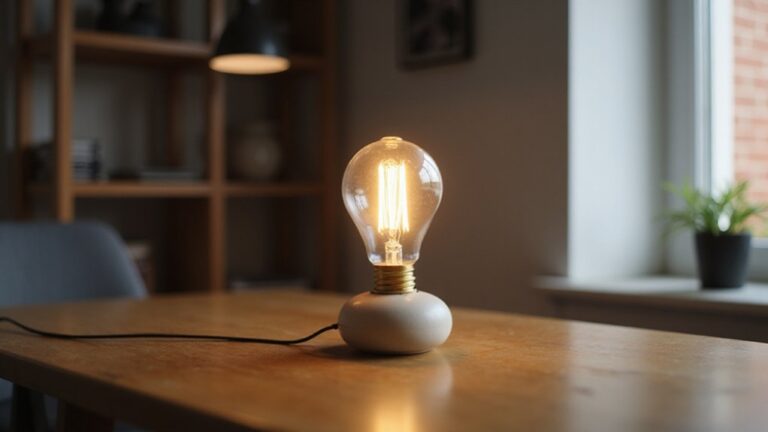

Ever wonder how just a simple touch can turn on a lamp? It’s more than just a trick — it’s a clever use of electrical signals and tiny changes in how circuits behave.
When you make contact with a touch lamp, your body influences its internal electronics, causing it to light up or adjust brightness.
Here’s how those subtle signals actually work, and why your lamp might sometimes turn on by itself.
Why Your Touch Lamp Knows It’s You Being Touched
Your touch lamp recognizes your touch because your body acts like a small capacitor, usually adding about 10 picofarads of capacitance. This change increases the lamp’s base capacitance from around 5 pF to roughly 15 pF. The circuit measures this shift in capacitance, which is significant enough for the sensor to detect. Non-conductive objects like plastic do not add enough charge to trigger the sensor, making your biological water content and electron-holding ability key to the process. This selective detection is analogous to how one-way window film allows you to see outside while preventing outsiders from looking in, relying on a specific property of light rather than capacitance. The system filters out background noise to focus only on genuine human-sized capacitance changes, ensuring that your touch reliably triggers the lamp without false alarms. When the lamp uses an LED bulb, capacitive coupling can interact with the bulb’s driver circuit, sometimes causing a subtle flicker that requires a compatible dimmer to resolve. This principle builds on a 1954 patent by Norman Green, which used vacuum tubes and a latching relay to achieve proximity-activated lamp control. For a desk setup that prioritizes function over vanity, a similar capacitive sensor can be built into a workspace lamp to avoid the decorative distractions of a vanity mirror.
How a Touch Lamp’s Oscillator Detects Your Finger
The oscillator detects your finger by its change in capacitance, which typically adds a few picofarads to the circuit. When you touch the metallic plate connected to the oscillator, your body’s high water content introduces an extra capacitive load. This load shifts the oscillator’s frequency or can even stop it altogether. The circuit continuously monitors these frequency changes to identify when you have touched the plate. Because the oscillator runs at high frequency and produces harmonic signals, even small variations caused by your touch are detectable. To avoid false triggers from circuit noise or environmental conditions, the oscillator must be stable and resistant to drift. When a sudden frequency shift occurs, the enhanced circuitry recognizes this as a genuine touch, allowing the lamp to respond confidently.
The Physics That Makes Your Touch Lamp Respond to Skin
Your body responds to a touch lamp because your skin acts like a capacitor with a capacitance of about 10 picofarads, which adds to the lamp’s baseline of 5 picofarads. This increased capacitance triggers the lamp’s sensing circuit. The key mechanism is capacitive coupling, where your skin and the lamp’s sensor share an electric field without any direct current flowing. The polar water molecules in your skin have dielectric properties—they effectively store charge—making your body a good conductor for this purpose. When you touch the lamp, the total capacitance rises from 5 pF to roughly 15 pF, and the oscillator inside the lamp detects this change. Only materials with high water content and conductivity, like skin or certain foods and drinks, can store enough charge to activate the sensor. For proper functionality, the lamp’s built-in oscillator requires a consistent baseline capacitance, which is why selecting the right dimmer switch for your home is equally important when integrating other lighting controls. Similarly, objects such as soap or fruit can trigger the lamp due to their charge storage capability. Insulators such as plastic or paper lack significant capacitance and therefore cannot turn the lamp on or off. For DIY enthusiasts building similar capacitive sensors, understanding budget-friendly material choices like aluminum foil or copper tape can reduce project costs. Tungsten bulbs, by contrast, rely on resistive heating rather than capacitive sensing, so they are less affected by skin capacitance in their standard operation.
Why Touch Lamp Metal Parts Act Like an Antenna
The metal parts of a touch lamp act like antennas because they are designed to pick up ambient electrical noise, which are tiny electromagnetic signals present in the environment. These metal components are highly conductive, allowing them to efficiently capture this electromagnetic interference. When you touch the metal, your body also functions as a large antenna, substantially increasing the amount of electrical noise picked up. This results in a stronger signal that the lamp’s internal amplifier detects, triggering the switch. Essentially, your body completes a circuit by conducting this electrical energy, providing enough signal boost for the lamp to respond to your touch. For those looking for reliable illumination, reviewing the best night lights can help identify models that balance sensitivity and performance. Similarly, selecting the correct standard sizes for curtain rods ensures they fit your windows properly.
Three Duty Cycles That Control Touch Lamp Brightness
Your touch activates brightness changes through sensor calibration, which continuously monitors the lamp’s baseline capacitance. When you tap the lamp, it advances through three preset duty cycles—low, medium, high—and then turns off. These duty cycles control the amount of power delivered to the bulb, effectively adjusting brightness without any mechanical switch. The circuit rapidly switches the bulb on and off about 100 times each second, creating the illusion of smooth, flicker-free brightness adjustments. This method ensures seamless transitions between different light levels, providing a more refined user experience. For those seeking cost-effective lighting upgrades, applying window film costs can similarly enhance a home’s ambience through a straightforward DIY approach. Building a storage bin rack provides another cost-effective way to organize home items using basic materials and simple steps. A can light conversion kit offers a practical way to upgrade existing recessed lighting fixtures with pendant-style options.
What Makes Touch Lamps Safe Despite Running on Electricity?
Touch lamps are safe despite running on electricity because the sensing signals operate at extremely low levels—typically millivolts and microamps—far below the threshold that could cause harm. These tiny currents are undetectable to your skin and cannot deliver a shock. The system’s capacitive isolation physically separates the touch circuit from the mains voltage, ensuring that even if a component fails, you cannot receive a high-voltage shock. A built-in microchip filters out electrical noise and electromagnetic interference, preventing erratic behavior or false triggers. Reputable brands adhere to safety standards like UL certification, which verifies the lamp’s compliance with strict safety requirements, including the use of flame-resistant materials and proper grounding. Although component failure is possible, proper design and certification significantly reduce any risk, ensuring that you only handle harmless signals rather than high-voltage power. If you need to replace the bulb, refer to your guide for changing a ceiling light fixture for safe electrical practices.
Why Your Touch Lamp Turns On by Itself
Component aging is a common cause of a touch lamp turning on by itself. Over time, internal parts like sensors, capacitors, and circuit boards can drift from their original calibration, making the lamp overly sensitive to small changes in capacitance. This leads to unintended activations without contact. As these components degrade, electrical stability decreases, increasing the likelihood of false triggers. Regularly inspecting and replacing aging parts can help maintain proper calibration and prevent spontaneous activation.